


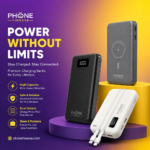
Power banks explain the key choices, value factors, and practical details readers need before making a decision. Portable charger technology has become an everyday necessity for commuters, travelers, remote workers, and anyone who depends on a smartphone throughout the day. A reliable power bank can prevent low-battery warnings from interrupting navigation, work calls, photography, entertainment, or emergency communication. Today’s best models are faster, slimmer, and more versatile than older battery packs, offering features such as wireless charging, USB-C Power Delivery, magnetic alignment, and intelligent safety protection.
Power Banks: What Is a Portable Charger?
For another helpful perspective, this Power Banks highlights practical trade-offs for buyers. A portable charger is a rechargeable battery pack designed to restore power to mobile devices away from a wall outlet. Most models include one or more USB ports, while newer versions may support wireless charging or magnetic attachment. Capacity is measured in milliamp-hours, or mAh, which indicates how much energy the battery can store. For more buying guidance, see this portable charger guide.
For another helpful perspective, this Power Banks highlights practical trade-offs for buyers. A compact 5,000mAh charger may provide a partial or full smartphone charge, depending on the phone’s battery size and energy lost during conversion. A 10,000mAh model typically offers a practical balance between capacity and portability. Larger 20,000mAh chargers are better suited to long trips, tablets, cameras, handheld gaming devices, and multiple users, although they are heavier.
The most useful charger is not necessarily the one with the highest capacity. It should match your devices, daily routine, and preferred charging method.
Power Banks: Key Features to Consider Before Buying a Power Bank
Several technical details determine how useful a power bank will be in everyday situations.
Power Banks: Capacity and Size
Capacity affects how many times a charger can replenish a device before needing to be recharged itself. A 5,000mAh unit is easy to carry in a pocket, while a 10,000mAh option offers greater flexibility without becoming too bulky. Large-capacity models are valuable for camping and travel but may be less convenient for daily use.
Manufacturers often list the battery’s internal capacity, while the usable output is lower because energy is lost during voltage conversion. This means a 10,000mAh charger will not always deliver a full 10,000mAh directly to your phone.
Output Wattage
Output wattage determines charging speed. Basic models may deliver 10W to 12W, while modern USB-C chargers can reach 20W, 30W, 45W, or more. Check your phone, tablet, or laptop’s requirements before choosing a model. A high-wattage charger is especially helpful for devices that support USB-C Power Delivery. The USB-IF overview of USB Power Delivery explains how this charging standard delivers power to compatible devices.
Ports and Compatibility
A good power bank may include USB-C input and output, USB-A output, or multiple ports for charging several devices at once. USB-C is increasingly preferred because it supports faster charging and works with newer phones, tablets, headphones, cameras, and laptops.
Port availability matters when traveling with multiple devices. However, charging several products simultaneously can reduce the maximum output available to each one, so review the manufacturer’s specifications.
Safety Protection
Look for protection against overcharging, overheating, short circuits, and excessive current. Reputable brands use battery management systems that regulate power and help protect both the charger and connected devices. Certifications and clear warranty information are also useful signs of quality.
Fast Charge Power Bank Options for Busy Days
A fast charge power bank is ideal for people who need meaningful battery recovery in a short period. Rather than waiting hours for a phone to recharge, fast-charging technology can restore enough power during a coffee break, train ride, or airport stop.
USB-C Power Delivery is one of the most common fast-charging standards. Depending on the device and charger, it can provide significantly higher power than older USB connections. Some models also support programmable power supply technology, which adjusts voltage and current more precisely for compatible devices.
Fast charging only works when the entire setup supports it. The power bank, cable, and device must all be compatible with the required charging standard. A high-output battery pack connected through an old or damaged cable may charge slowly. For best results, use a quality USB-C cable rated for the intended wattage.
Choosing a MagSafe Power Bank
A MagSafe power bank is designed for compatible iPhones and attaches magnetically to the back of the phone. This eliminates the need to carry or connect a cable during short charging sessions. Magnetic alignment helps keep the charging coil in the correct position, making wireless charging more convenient than placing a phone loosely on a standard wireless pad.
The main benefit is convenience. A magnetic charger can remain attached while you hold the phone, check messages, or walk around. However, wireless charging usually produces more heat and may be less energy-efficient than wired charging. It may also charge more slowly, particularly while the phone is being used heavily.
Before buying, verify compatibility with your phone model and case. Thick cases, wallets, metal accessories, and poorly aligned magnetic rings can weaken the connection. Some third-party models work with magnetic-compatible Android phones as well, but compatibility and charging performance vary.
Why a Slim Wireless Power Bank Is Useful
A slim wireless power bank is a practical choice for users who prioritize portability and convenience. Its thin design can fit inside a small bag, jacket pocket, or laptop sleeve, while wireless functionality reduces cable clutter.
Slim models generally have lower capacity than larger battery packs, but that is not necessarily a disadvantage. They are designed for quick top-ups rather than extended off-grid use. A 5,000mAh wireless model can be particularly useful during a workday, shopping trip, or evening out when you need extra battery without carrying a heavy accessory.
When comparing thin wireless models, examine thickness, weight, magnetic strength, charging speed, and whether the device can charge through a case. Built-in stands, LED indicators, pass-through charging, and USB-C output can add value, but unnecessary features may increase size or cost.
Wired Versus Wireless Charging
Wired charging remains the fastest and most efficient option for most devices. It typically produces less heat and allows a power bank to deliver its full advertised output more effectively. Wireless charging is more convenient because it removes the need for a cable, but it can be slower and may consume more energy.
Many of the best chargers combine both methods. You can use wireless charging for convenience and switch to USB-C when the battery needs to recover quickly. This hybrid design is useful for travelers who want flexibility without carrying multiple accessories.
Practical Tips for Using a Portable Charger
Keep the power bank away from extreme heat, direct sunlight, and moisture. Do not use a charger with a swollen battery, damaged casing, frayed cable, or unusual odor. Recharge it using a compatible wall adapter, and avoid leaving it connected unnecessarily for long periods if the manufacturer advises against it.
For travel, check airline rules before packing a high-capacity model. Portable batteries are generally required to remain in carry-on luggage rather than checked baggage, and very large-capacity units may require approval.
Finally, recharge the battery pack before important trips. A portable charger is most valuable when it is ready to use, not sitting empty in a drawer.
Finding the Best Power Bank for Your Needs
The best choice depends on how and where you charge. Select a compact 5,000mAh model for emergency top-ups, a 10,000mAh fast charge power bank for everyday use, or a larger high-capacity unit for extended travel and multiple devices. Choose a MagSafe power bank if magnetic convenience is your priority, or a slim wireless power bank if you want cable-free charging in a pocket-friendly design.
By comparing capacity, output, compatibility, safety features, and physical size, you can find a portable charger that delivers dependable power without adding unnecessary weight to your daily routine.