


Portable charger technology has transformed the way people stay connected while traveling, commuting, working, and enjoying the outdoors. A reliable power bank can prevent low-battery warnings from interrupting navigation, communication, entertainment, or productivity. With options ranging from compact wired models to magnetic wireless designs, choosing the right charger depends on your devices, charging habits, and daily routine.
Why a Portable Charger Is Essential
Modern smartphones, tablets, wireless earbuds, smartwatches, cameras, and gaming devices all rely on rechargeable batteries. Even phones with impressive battery life can run out of power during long trips or busy days. A portable charger provides a convenient backup without requiring access to a wall outlet.
The best model should offer enough capacity for your devices while remaining easy to carry. It should also include appropriate safety features, useful charging ports, and sufficient output for fast and efficient recharging. A small power bank may be perfect for occasional emergency use, while a larger model is better suited to travel, camping, or charging multiple devices.
Portable Charger: Choosing the Right Power Bank Capacity
Manufacturers measure capacity in milliampere-hours, or mAh. A compact 5,000mAh power bank can often provide a partial or full smartphone charge, depending on the phone’s battery size and the charger’s efficiency. These models are typically lightweight and easy to keep in a pocket or small bag.
A 10,000mAh power bank offers a practical balance between portability and charging ability. It can generally recharge most smartphones more than once and is a popular choice for commuting, workdays, and short trips. Larger 20,000mAh models provide several phone charges and may also support tablets, handheld gaming consoles, or other high-capacity devices.
However, the advertised capacity does not equal the exact amount of usable energy delivered to a device. Power conversion creates some energy loss, so real-world performance is usually lower than the printed rating. Buyers should also consider physical size and weight, since higher capacity often means a larger battery.
Portable Charger: Fast Charge Power Bank Features to Look For
A fast charge power bank can significantly reduce waiting time, but speed depends on more than the battery’s capacity. Check the output wattage and supported charging standards before purchasing. Modern smartphones, tablets, laptops, and gaming devices commonly use USB-C Power Delivery, also called USB-C PD.
Some models support 18W, 20W, 30W, or higher output. A 20W charger may be sufficient for many phones, while tablets and some laptops may require 30W, 45W, or more. The connected device determines how much power it can accept, so a high-output bank will not necessarily charge every product at its maximum speed.
Look for pass-through charging if you want to recharge the power bank while charging another device. This feature can be useful on a nightstand or during travel, although it may charge both devices more slowly. Multiple ports help families and users who carry a phone, earbuds, smartwatch, and tablet.
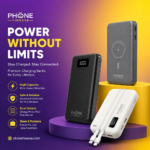
For a compact option that combines several charging functions, consider the 45 W magnetic wireless power bank with an Apple Watch charger.
The Convenience of a MagSafe Power Bank
A MagSafe power bank attaches magnetically to the back of a compatible iPhone. This eliminates the need for a dangling cable during charging and makes it easier to use the phone while it receives power. Magnetic alignment also helps keep the charging coil in the correct position.
When shopping for one, check compatibility with your phone case. Thick, nonmagnetic, or poorly aligned cases can weaken the connection. A MagSafe-compatible case may improve attachment and charging reliability. It is also important to distinguish between magnetic attachment and certified wireless charging performance. Some products use magnets for alignment but do not deliver the same charging speeds as officially supported accessories.
Magnetic power banks are particularly useful for commuting, taking photos, navigating, or watching videos while traveling. Their main limitation is capacity: compact magnetic models may hold less energy than larger wired power banks, and wireless charging can produce more heat and energy loss.
Is a Slim Wireless Power Bank Right for You?
A slim wireless power bank combines portability with cable-free charging. Its thin profile makes it easy to carry in a jacket pocket, purse, or laptop sleeve. This design is ideal for users who value convenience and want to avoid carrying extra charging cables.
Wireless charging is simple, but it usually works more slowly than a direct USB-C connection. Alignment, phone case thickness, battery temperature, and charging protocol can all affect performance. For urgent charging, a wired connection is often faster and more efficient. A versatile slim wireless power bank with both wireless charging and USB-C output provides the best of both approaches.
Before buying, review the bank’s wireless charging standard and maximum output. Also look for temperature control, foreign-object detection, overcharge protection, and short-circuit protection. These features help keep both the charger and the connected device safe.
Important Safety and Design Features
Safety should be a priority when selecting any rechargeable battery accessory. Choose products from reputable manufacturers that clearly list their specifications and safety certifications. Essential protections include overcharging, over-current, over-voltage, overheating, and short-circuit prevention.
A durable exterior is valuable for frequent travelers. Scratch-resistant materials, reinforced corners, and a secure USB-C port can extend the product’s lifespan. An LED display showing the remaining battery percentage provides more precision than a simple row of indicator lights, although basic lights are often sufficient for casual use.
Air travel rules may also affect which power bank you can bring. Most airlines require travelers to carry spare lithium batteries in hand luggage rather than checked baggage, and limits may apply to watt-hours. Before traveling, review the FAA’s lithium battery travel guidance and verify your airline’s current regulations.
Matching the Charger to Your Lifestyle
For everyday emergency use, a lightweight 5,000mAh or 10,000mAh model is usually enough. Frequent travelers may prefer a 20,000mAh power bank with multiple ports and USB-C PD. iPhone users who prioritize convenience may benefit from a MagSafe power bank, while users who want flexibility should choose a model offering both wireless and wired charging.
The ideal portable charger is not necessarily the largest or fastest option. It is the one that fits your devices, charging needs, budget, and carrying habits. By comparing capacity, output, charging standards, safety features, and size, you can choose a dependable power bank that keeps your essential technology ready throughout the day.