



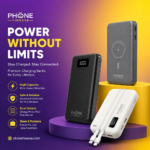
Portable power bank technology helps people stay connected while traveling, commuting, working, and exploring. A reliable battery pack provides backup power without requiring an outlet. Today, modern models are faster, slimmer, and more versatile than earlier designs. For example, they can charge smartphones, tablets, earbuds, cameras, handheld consoles, and some laptops.
Why a Portable Power Bank Is an Everyday Essential
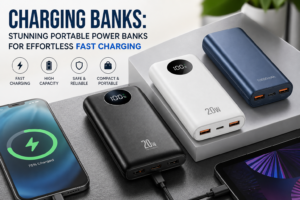
A portable power bank stores energy in an internal battery. It then transfers that energy through wired or wireless connections. As a result, the best models support full-day travel, long meetings, outdoor activities, airport layovers, and busy work schedules without adding much bulk.
Capacity usually appears in milliamp-hours (mAh). However, watt-hours (Wh) offer a more accurate comparison for larger devices. A compact 5,000mAh unit can provide a quick phone boost. Meanwhile, a 10,000mAh or 20,000mAh model can deliver several charges. Higher-capacity options suit tablets, cameras, and laptops, but they weigh more. In addition, airline rules may limit them. For more buying guidance, see our portable power bank guide.
Portable Power Bank: Fast-Charging Portable Charger Performance
A fast-charging portable charger can reduce the time needed to restore a device’s battery. However, charging speed depends on the bank’s output, the device’s maximum input, the cable, and the supported charging protocol.
Therefore, choose a model that lists its wattage clearly. Do not rely only on terms such as “quick charge.” For many modern smartphones, a 20W model suits everyday needs. Higher outputs, meanwhile, help with tablets and computers. Built-in safeguards should also prevent overheating, overcharging, short circuits, and excessive current.
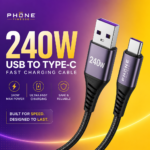
USB-C matters because many current models use it for both input and output. Consequently, one USB-C cable can recharge the bank and power a compatible device. This setup reduces the number of accessories you need.
Portable Power Bank: USB-C PD Power Bank for Phones, Tablets, and Computers
A USB-C PD power bank uses USB Power Delivery to negotiate the right voltage and current. This process enables efficient, adaptable charging instead of a fixed power level.
For smartphones, 20W to 30W often provides enough power. Tablets may benefit from 30W or 45W. Similarly, many lightweight laptops need 45W, 65W, or more. Before buying, check the laptop’s original charger requirements. Otherwise, an underpowered bank may charge slowly or fail to charge the computer during use.
A quality USB-C PD power bank should include a labeled USB-C port and reliable cable compatibility. It should also provide enough capacity for the intended device. In addition, some models include USB-C and USB-A ports, so users can charge different devices at once.
MagSafe Magnetic Power Bank Convenience
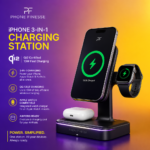
A MagSafe magnetic power bank attaches to compatible iPhones. As a result, it removes the need for a dangling cable during short charging sessions. This convenience helps with commuting, navigation, and mobile photography.
Magnetic alignment keeps the charging coils positioned correctly. However, confirm compatibility with your phone and case. Thick, textured, or non-MagSafe cases can weaken the connection. Wireless charging may also create more heat and run slower than wired USB-C charging. Therefore, a model with both magnetic and wired output offers greater flexibility.
OLED Smart Digital Display Power Bank Features
An OLED smart digital display power bank shows its remaining capacity, often as a percentage. This reading gives more precision than blinking indicator lights. It also helps you decide when to recharge the unit.
Some displays show output wattage, charging status, temperature, or the active port. These details help people who charge several devices or monitor power delivery. For outdoor use, choose a display that remains readable indoors and outdoors. Convenient controls, durable buttons, and automatic shutoff can also improve the experience.
Laptop Portable Charger for Mobile Productivity
A laptop portable charger helps professionals and students work when outlets are unavailable. Generally, these models offer more capacity and higher USB-C output than phone-focused banks.
Check three specifications before buying: maximum output wattage, total capacity, and port compatibility. For example, a laptop with a 65W charger will perform best with a bank that delivers at least 65W through USB-C PD. Some computers need proprietary adapters. Others, however, charge directly through USB-C.
Laptop-capable banks hold substantial energy, so they can weigh more. Consequently, travelers should check airline rules before packing high-capacity models. The FAA’s lithium battery guidance explains important carry-on requirements.
Ultra-Slim Pocket Power Bank Design
An ultra-slim pocket power bank prioritizes portability. It fits in a jacket pocket, purse, or small compartment. Therefore, this design suits short trips and daily commutes.
Slim models usually offer less capacity than larger units. Still, that trade-off works well for users who want lightweight backup power. Look for rounded edges, a textured surface, strong port covers, and secure cable storage. Integrated cables reduce clutter. Alternatively, detachable cables are easier to replace and may support faster charging.
Eco-Friendly Bioplastic Power Bank Materials
An eco-friendly bioplastic power bank can reduce reliance on conventional petroleum-based plastics. Its housing may include plant-derived or recycled materials. Nevertheless, the design must still provide enough durability for everyday use.
Sustainable purchasing also involves battery life and repairability. A bank that lasts several years creates less waste than one that quickly loses capacity. Therefore, choose responsible packaging, clear recycling guidance, efficient circuitry, and a reputable warranty. At the end of its life, take the unit to an approved electronics or battery recycling facility. Never place it in household trash.
Multi-Device Charging Brick for Busy Routines
A multi-device charging brick combines portable battery storage with several ports. It can power a phone, smartwatch, earbuds, tablet, or camera at the same time. As a result, this setup helps families, business travelers, and remote workers.
Check the total output when you connect multiple devices. Some banks reduce wattage across ports. Others prioritize a high-power USB-C connection. Additionally, port placement matters. Widely spaced ports accommodate bulky cables and adapters without blocking nearby sockets.
To compare capacity, speed, and design, browse our power bank recommendations. You can then match a model to your devices and daily routine.
High-Wattage Power Station for Extended Use
A high-wattage power station suits camping, emergency backup, photography, fieldwork, and off-grid use. These larger units may include AC outlets, USB ports, DC outputs, lights, and substantial battery capacity.
Unlike a pocket bank, a power station can run demanding equipment. For example, it can support laptops, monitors, small appliances, drones, and some medical devices. Consider weight, charging time, and battery chemistry. Newer models may use lithium iron phosphate batteries. In turn, these batteries can provide strong cycle life and improved thermal stability.
Choosing the Right Charging Bank
The ideal charging bank balances capacity, output, size, compatibility, and safety. For occasional phone emergencies, an ultra-slim model may be enough. Frequent travelers may prefer a 10,000mAh or 20,000mAh USB-C PD option. Likewise, laptop users should prioritize wattage and capacity. iPhone owners may value magnetic convenience.
Finally, use certified cables and keep the battery away from extreme heat. Stop using it if the casing swells or becomes unusually hot. Ultimately, a well-made charging bank does more than provide emergency power. It helps modern devices stay ready wherever life takes you.