


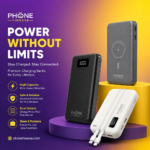
High-capacity power bank options have become essential for travelers, commuters, remote workers, and anyone who relies on mobile devices throughout the day. Today’s charging banks offer faster speeds, greater battery capacity, and smarter features than ever before. Therefore, choosing the right model depends on what you need to charge, how often you travel, and whether portability or maximum output matters most.
What to Look for in a High-Capacity Power Bank
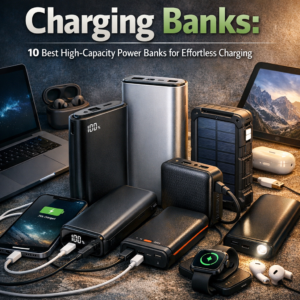
For another helpful perspective, this High-Capacity Power Bank highlights practical trade-offs for buyers. For another helpful perspective, our guide to portable chargers for fast charging explains practical trade-offs for buyers. Manufacturers measure battery capacity in milliamp-hours, or mAh. A 10,000mAh model often suits daily smartphone use, while a 20,000mAh or larger unit can provide multiple phone charges or power tablets, cameras, handheld consoles, and other devices. However, capacity represents only one part of the equation.
Output wattage determines how quickly a power bank can charge your devices. A basic model may offer 10W to 18W, while a fast-charging portable charger can deliver 20W, 30W, 65W, or more. In particular, USB-C Power Delivery, commonly called USB-C PD, supports compatible phones, tablets, laptops, and accessories through a single versatile port. The USB Implementers Forum overview of USB Power Delivery explains how this charging standard manages power between compatible devices.
It is also worth checking the number and type of ports, recharge time, safety protections, weight, and display features. Additionally, compare everyday options and specialized designs before choosing the right charging bank.
10 Best High-Capacity Power Bank Types for Effortless Charging
High-Capacity Power Bank: 1. 20,000mAh USB-C PD Power Bank
A 20,000mAh USB-C PD power bank offers one of the most practical choices for frequent travelers and heavy smartphone users. It can typically recharge a modern phone several times and may power tablets or smaller laptops, depending on its wattage. Look for models offering at least 30W output, along with USB-C input for faster recharging.
As a result, this type balances capacity and portability for flights, business trips, and long days away from a wall outlet.
2. 65W Fast-Charging Portable Charger
A 65W fast-charging portable charger serves users who need more than basic phone charging. With sufficient output, it can power ultrabooks, tablets, smartphones, wireless headphones, and other accessories. It is particularly useful for students and remote workers who move between offices, cafés, and travel locations.
Moreover, multiple charging protocols improve compatibility, while built-in temperature and overcurrent protection help keep connected devices safe.
3. MagSafe Magnetic Power Bank
A MagSafe magnetic power bank provides cable-free convenience for compatible iPhones. It attaches magnetically to the back of the phone, allowing users to charge while holding or using the device. Its compact shape is ideal for quick boosts during commutes or social events.
Although magnetic charging offers considerable convenience, it may work more slowly than wired USB-C charging. Buyers should also consider magnetic alignment, battery capacity, heat management, and pass-through charging support.
4. OLED Smart Digital Display Power Bank
An OLED smart digital display power bank shows the remaining battery percentage more precisely than a row of indicator lights. Consequently, this feature eliminates guesswork and helps users know when the unit needs recharging.
Digital displays are particularly useful for travelers, photographers, and professionals who depend on backup power. Some advanced models also show output power, charging status, or estimated runtime, making them helpful for managing several devices throughout the day.
5. Laptop Portable Charger
A laptop portable charger must provide adequate wattage and the correct charging standard for a computer. Models rated at 65W, 100W, or higher generally suit USB-C laptops, although requirements vary by device.
When selecting one, check the laptop’s original charger specifications. A power bank with insufficient wattage may charge slowly, maintain the battery level, or fail to power the laptop while it runs. Larger laptop chargers may weigh more, but their extra capacity and output make them valuable for extended work sessions away from an outlet.
6. Ultra-Slim Pocket Power Bank
An ultra-slim pocket power bank prioritizes convenience over maximum capacity. These models fit easily in a jacket pocket, handbag, or small travel pouch and work well for emergency charging.
Most offer enough energy for a partial or full phone charge, depending on battery size. Therefore, they suit everyday commuters who want backup power without carrying a bulky accessory.
7. Eco-Friendly Bioplastic Power Bank
An eco-friendly bioplastic power bank uses plant-based or recycled materials in parts of its exterior. While manufacturing, longevity, packaging, and recycling practices also affect environmental impact, more sustainable construction can reduce reliance on conventional plastics.
Choose a durable model with replaceable cables, dependable safety features, and a long expected service life. In general, a product that lasts for years proves more sustainable than one that needs frequent replacement.
8. Multi-Device Charging Brick
A multi-device charging brick combines a high-capacity battery with several charging ports. It may include USB-C, USB-A, wireless charging, or dedicated low-power outputs for earbuds and smartwatches.
This type of power bank works especially well for families, content creators, and travelers carrying multiple devices. Before purchasing, confirm the total shared output. A unit may advertise high wattage but divide that power between ports when several devices connect.
9. Solar-Assisted Power Bank
A solar-assisted power bank includes a small solar panel for emergency or outdoor use. Its panel usually recharges the internal battery slowly, so users should not treat it as a complete replacement for wall charging.
These models help during camping trips, hiking excursions, and emergencies. In addition, rugged construction, water resistance, a built-in flashlight, and dependable USB output often matter more than the solar panel’s size.
10. High-Wattage Power Station
A high-wattage power station provides the strongest option for extended off-grid charging. These larger units can power laptops, monitors, cameras, small appliances, and multiple mobile devices. Some include AC outlets, USB-C PD ports, car sockets, and integrated lighting.
Although less portable than a traditional power bank, a power station suits camping, road trips, home backup, and outdoor work. Capacity is commonly measured in watt-hours, which gives users a clearer indication of how much total energy the station stores.
How to Choose the Right Charging Bank
Start by listing the devices you expect to charge. A smartphone user may need only a compact 10,000mAh unit, while a laptop owner should prioritize USB-C PD and higher wattage. For several devices, choose a multi-port model with intelligent power distribution.
Portability also deserves careful consideration. A large battery provides more charging cycles but adds weight. If the power bank stays in a backpack or travel case, that extra weight may not matter. For pockets and small purses, however, an ultra-slim model proves more practical.
Finally, look for reputable safety features, including overcharging, overheating, short-circuit, and surge protection. Certifications, durable construction, and a dependable warranty can also indicate better long-term value.
Ultimately, the best charging bank is not necessarily the largest or most powerful model. Instead, choose the one that matches your devices, lifestyle, and charging habits while offering dependable performance wherever the day takes you.