
Wireless headsets have become essential tools for work, gaming, travel, and everyday communication. In particular, the best models combine clear sound, dependable microphones, comfortable designs, and reliable battery life without forcing users to deal with tangled cables. Whether you need an office headset with mic for long meetings, a wireless gaming headset for immersive play, or a compact Bluetooth headset for calls on the go, the right choice depends on how and where you plan to use it.
What to Look for in Wireless Headsets
Before choosing a headset, consider comfort, microphone quality, connection stability, battery performance, and device compatibility. A headset that sounds excellent but becomes uncomfortable after an hour may not be suitable for a full workday. Likewise, a model with impressive music playback may deliver disappointing voice quality during meetings.
Wireless headsets generally connect through Bluetooth, a USB receiver, or both. Bluetooth is convenient for smartphones, tablets, and laptops, while USB receivers often provide lower latency and a more stable connection for computers and consoles. Additionally, some premium headsets support simultaneous connections, allowing users to switch between a laptop and phone without repeatedly pairing devices. The official Bluetooth overview explains how the technology supports connections across everyday devices.
Battery life is another important factor. However, many modern headsets provide between 20 and 60 hours of use per charge, although active noise cancellation and high-volume listening can reduce that figure. Fast charging is helpful when a headset needs a quick boost before a meeting or gaming session.
Best Wireless Headsets for Work and Remote Meetings
A quality remote work headset should make conversations easy to hear while ensuring that your voice sounds natural to colleagues. Therefore, look for a flexible boom microphone, microphone noise reduction, comfortable ear cushions, and controls that are easy to reach.
An office headset with mic is particularly useful for employees who spend several hours each day in video conferences. Over-ear models often provide better passive noise isolation and reduce distractions in busy environments. In contrast, on-ear designs can feel lighter, but they may allow more background sound to enter.
A Zoom-compatible wireless headset should work smoothly with common video conferencing platforms, including Zoom, Microsoft Teams, Google Meet, and Skype. Compatibility usually depends more on the computer’s Bluetooth or USB support than on the app itself. However, headsets certified for business platforms may include dedicated mute controls, call indicators, and software integration that improves the meeting experience.
For remote workers, microphone performance is just as important as speaker quality. For example, beamforming microphones can focus on the user’s voice and reduce typing, fan, or household noise. Some models also offer a flip-to-mute boom, making it easy to silence the microphone instantly.
Wireless Headsets for Calls and Customer Service
A call center Bluetooth headset should prioritize vocal clarity, comfort, and dependable connectivity. Because customer service professionals may wear a headset for most of the day, lightweight construction and breathable padding are essential. A rotating microphone boom is useful for switching between the left and right sides, while a visible mute indicator helps prevent accidental audio transmission.
Wireless headphones with a mic can be practical for hybrid workers who want one device for calls, music, and general computer use. However, not every built-in microphone performs equally well. Headsets designed primarily for music may use small internal microphones that sound less focused than a dedicated boom microphone.
For frequent phone users, check whether the headset supports multipoint Bluetooth. This feature allows the device to remain connected to two sources, such as a smartphone and a work laptop. As a result, incoming calls can be answered without manually disconnecting from another device.
Over-Ear Wireless Headset Benefits
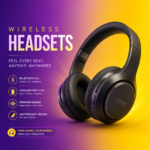
An over-ear wireless headset surrounds the ears with cushioned ear cups, creating a comfortable seal that can improve sound quality and reduce external noise. This design is often preferred by people who work in open offices, travel frequently, or enjoy long gaming sessions. For a product option with long battery life and adaptive noise cancellation, explore these wireless headphones.
Over-ear models usually deliver stronger bass and a wider soundstage than smaller headsets. They also have more space for larger batteries, microphones, and control systems. Still, the main disadvantages are increased size and weight. A good model should use a well-padded headband and adjustable hinges to distribute pressure evenly.
When evaluating comfort, pay attention to clamping force, ear cup depth, material quality, and ventilation. Memory foam cushions covered in fabric may feel cooler than synthetic leather, while leather-style padding can provide better passive isolation and easier cleaning.
Choosing a Wireless Gaming Headset
A wireless gaming headset should offer low latency, accurate positional audio, and a microphone that keeps teammates’ voices clear. Because delayed sound can affect competitive gameplay, gaming-focused models often use dedicated USB transmitters instead of standard Bluetooth.
Many wireless gaming headsets support virtual surround sound or spatial audio. These features can help players identify footsteps, vehicle movement, and environmental details, although the results vary by game and software. For competitive play, a neutral sound profile is often better, while a bass-heavy profile may be more enjoyable for action games and entertainment.
Comfort is critical during long sessions. Look for breathable ear cushions, a balanced frame, and controls for volume, microphone mute, and game-chat mixing. Moreover, some models include a detachable microphone, making them more convenient for listening to music or traveling.
Noise Cancellation and Everyday Use
A noise cancelling headset uses microphones and digital processing to reduce steady background sounds such as airplane engines, air conditioners, and office chatter. Active noise cancellation is especially valuable for commuters and remote workers who need to concentrate.
Noise cancellation works best with consistent low-frequency sounds. However, it may be less effective against sudden voices, keyboard clicks, or nearby conversations. For the best results, choose a headset that combines active noise cancellation with a good physical seal around the ears.
Transparency or ambient modes are also useful. They allow outside sounds to pass through without removing the headset, which is convenient when listening for announcements or speaking briefly with someone nearby.
How to Match a Headset to Your Needs
The ideal headset depends on your main priority:
- Office work: Choose an office headset with mic, strong voice pickup, and comfortable padding.
- Remote meetings: Select a remote work headset with reliable computer connectivity and easy mute controls.
- Phone calls: A call center Bluetooth headset with multipoint support and a flexible microphone is a practical choice.
- Travel: Consider a noise cancelling headset with long battery life and a compact folding design.
- Gaming: Choose a wireless gaming headset with low latency, spatial audio, and a clear boom microphone.
- General use: Wireless headphones with a mic can handle music, calls, videos, and casual work.
Ultimately, the best wireless headsets balance performance and comfort rather than focusing on a single specification. A powerful battery is valuable, but only if the headset remains comfortable. Excellent noise cancellation is helpful, but it should not come at the expense of natural-sounding calls. By matching the headset’s design, connectivity, microphone, and features to your daily routine, you can enjoy clearer communication and better audio wherever you work, play, or travel.